On October 14, 2026, the UK's Competition and Markets Authority fined Wayfair £4.8 million. Its "Daily Deals" and 24-hour "Flash Deals" ran countdown timers, but many products stayed at the same price or lower after the clock hit zero. Appliances Direct was fined £1.2 million in the same announcement for countdown banners on discount codes that kept coming back for days.
Black Friday is on November 27. Timers and stock alerts are about to appear on thousands of Shopify product pages, and most of them will be fine. This guide shows where the line sits, and how to check your own store before the sale starts. It is practical guidance, not legal advice.
Urgency works, which is why regulators watch it
Scarcity messages change behaviour. The CMA's online choice architecture paper notes that "numerous experiments and studies" find an effect of scarcity claims on click-through rates and purchases. That is also why fake ones are tempting.
They are common, too. When EU consumer authorities checked 399 online shops in 2023, 148 used at least one manipulative design, and 42 ran fake countdown timers.
What the rules say
- United States. The FTC's staff report Bringing Dark Patterns to Light names three urgency tricks: a "baseless countdown timer" that resets or disappears, a "false limited time message" with no real deadline, and a "false low stock message" when stock isn't low. The FTC treats deceptive practices like these under Section 5 of the FTC Act.
- European Union. The Unfair Commercial Practices Directive already blacklists falsely saying a product is available only for a very limited time. On November 11, 2026, the Commission proposed a Digital Fairness Act that would ban dark patterns such as "fake claims that a product is almost sold out." It is a proposal for now, and goes to the European Parliament and Council next.
- United Kingdom. Since April 2025 the CMA can fine businesses directly, up to 10% of global turnover. Its November 2025 enforcement drive called out "misleading countdown timers, which are banned under the new regime."
The rules don't ban timers or stock alerts. They ban false ones. And consumer rules generally follow the shopper: if you sell to people in the UK or EU, expect their rules to apply, wherever your business is based.
The honest-urgency test

Before any timer or stock message goes live, ask four questions:
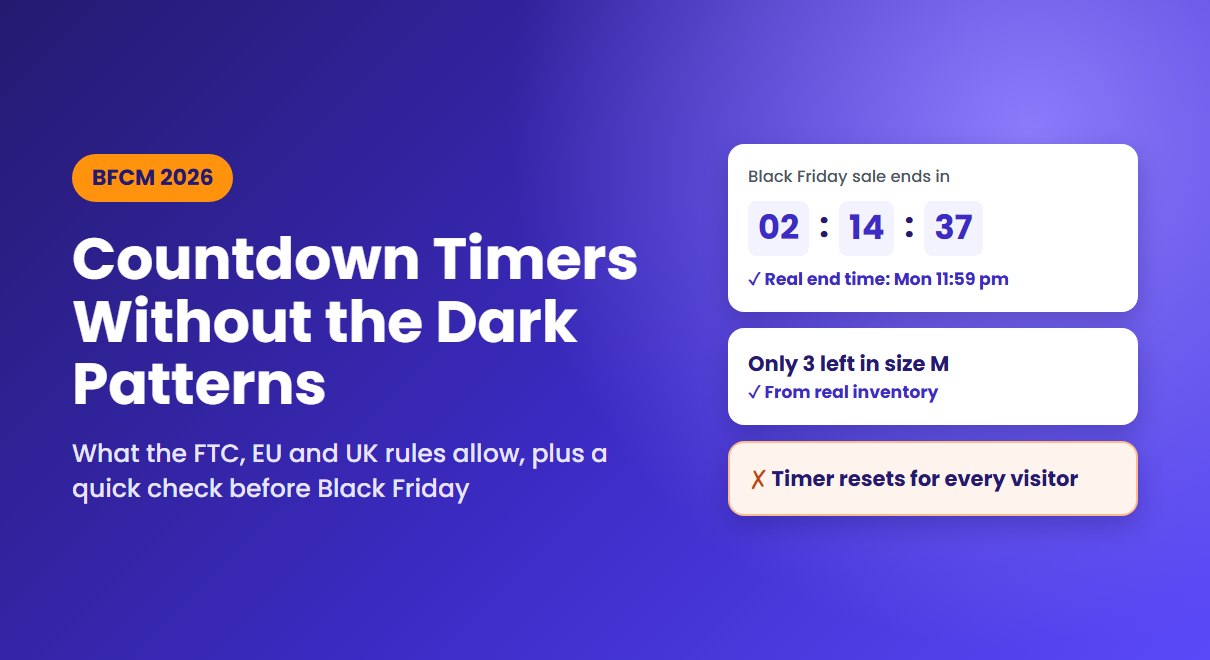
- Is the deadline real? Something must change when the clock reaches zero.
- Does the price go back up? If the deal is still there tomorrow, the timer was decoration.
- Is the number real? A stock count should come from your inventory, not a setting you picked.
- Does every shopper see the same thing? A timer that restarts for each new visitor is the classic fake.
If the answer to all four is yes, you are using urgency honestly.
Countdown timers: what's fine and what isn't
Fine: a timer that counts down to the real end of your Black Friday sale, a shipping cut-off for holiday delivery ("Order within 4 hours for dispatch today"), or a daily deal where the price really returns to normal at midnight.
Not fine: a per-visitor timer that starts at 15 minutes for everyone, a sale that quietly continues after the timer ends, or the same "limited" code reappearing every few days. The Wayfair and Appliances Direct cases were both about this second group.
Plan for the end of the sale, too. When Cyber Monday finishes, end the offer, remove the timer and put prices back. A sale that keeps getting "extended" turns every earlier deadline into a false one.
Low-stock alerts: what's fine and what isn't
Fine: "Only 3 left in size M" when your inventory says 3, shown only once stock drops below a threshold you set.
Not fine: a fixed "Only 2 left!" that never changes, a low-stock badge on items you restock every week, or "18 people are viewing this" when nobody is. The FTC report lists that last one as a false activity message.
Honest stock alerts also help shoppers. Someone choosing a gift in late November wants to know a size is running out.
A 15-minute urgency check before BFCM
- Open every product page with a timer and note what it counts down to.
- Open the same page in a private window. If the timer restarted, fix it.
- Compare each stock message with your Shopify inventory.
- Write down when each sale ends, and set a reminder to remove the timers.
- Check the cart recovery emails you send during the sale use the same deadline.
Our BFCM 2026 checklist covers the rest of your preparation, and the urgency section of our BFCM apps roundup compares timer apps.
Setting this up in Shopify
TimexBar, our countdown and stock timer app, offers scheduled, date-range and fixed-end-date timers. For BFCM, set the timer to a fixed end date that matches your discount, and keep stock messages tied to your real inventory. Then the timer, the discount and the stock count all tell shoppers the same thing.
Frequently asked questions
Are countdown timers legal on Shopify?
Yes, when they count down to a real deadline. What regulators in the US, EU and UK object to are fake timers that reset, disappear, or end while the offer carries on.
Can I show "only X left in stock"?
Yes, if the number comes from your real inventory. A fixed or invented number is a false low-stock message.
Does the EU Digital Fairness Act apply yet?
No. The Commission proposed it on November 11, 2026, and it still has to pass through the European Parliament and Council. Fake urgency is already banned under existing EU law.